commit 8a73d01May 11, 20217 min read
Using Highcharter in TidyTuesday's Internet Access data
Recreate The Verge's county-by-county map of the US broadband gap with highcharter and the tidyverse.
- R
- dataviz
- TidyTuesday

The data this week comes from Microsoft by way of The Verge.
Undoubtedly, the pandemic has brought with it a multitude of problems while enhancing the pre-existing ones. Many businesses, schools, or government procedures assimilated a digital model, while a large part of them closed their doors. Accessing those digital models became an almost inaccessible task. Years of unnoticed growth of this problem now stand out clearly. The issue of the broadband gap is now impossible to ignore. 🧐
You are a curious person. ✨ Microsoft’s The Verge designed an article about
the bandwidth gap problem in the United States. They generated a map that
highlights bivalence between counties that do not have a good internet
connection. In this blog, you will learn how to use highcharter and the
tidyverse ecosystem to create an essential replica of the map created
by The Verge. Are you ready? Let’s get started! 🙌
Libraries
In this blog, you will use:
- 📈
highcharterfor charts. - 🪣
janitorto clean the data. - 📥
tidyTuesdayRto download the data. - 📝
tidyversefor full data manipulation. - 🪞
widgetframeto transform the chart into an iframe.
library(highcharter)
library(janitor)
library(tidytuesdayR)
library(tidyverse)
library(widgetframe)
Get the data
tuesday_data <- tidytuesdayR::tt_load(2021, week = 20)Extract data to use
A full description of the data can be found in this github repository).
broadband <- tuesday_data$broadband %>%
  glimpse()
## Rows: 3,143
## Columns: 5
## $ ST <chr> "AL", "AL", "AL", "AL", "AL", "AL", "…
## $ `COUNTY ID` <dbl> 1001, 1003, 1005, 1007, 1009, 1011, 1…
## $ `COUNTY NAME` <chr> "Autauga County", "Baldwin County", "…
## $ `BROADBAND AVAILABILITY PER FCC` <chr> "0.81", "0.88", "0.59", "0.29", "0.69…
## $ `BROADBAND USAGE` <chr> "0.28", "0.30", "0.18", "0.07", "0.09…Download map data
In the broadband table, you will find five columns, of which, COUNTY ID
represents the identifier of the county in which the broadband usage
metrics are being performed.
Therefore, COUNTY ID can be used to locate the broadband usage values of
each county on a map. Here are several alternatives that you could make use of.
However, in this blog, you will use a map of the USA provided by the Highchart
team.
In particular, highcharter provides two utility functions for accessing and
browsing different common maps:
download_map_data(): Download the geojson data from the highchartsJS collection.get_data_from_map(): Get the properties for each region in the map, as the keys from the map data.
map_layout_data <- download_map_data("countries/us/us-all-all.js")If you look askance at the columns of the United States map, you will notice
that there is a column named fips; these are unique 5-digit codes to identify
counties in the United States. So, if you consider this, the COUNTY ID and
fips columns are equivalent. Yes, you may have to make a few adjustments
later, but stick with that idea for now. 👀👌
get_data_from_map(map_layout_data) %>%
  clean_names() %>%
  glimpse()
## Rows: 3,147
## Columns: 7
## $ hc_group <chr> "admin2", "admin2", "admin2", "admin2", "admin2", "admin2"…
## $ hc_middle_x <dbl> 0.21, 0.34, 0.05, 0.68, 0.55, 0.44, 0.53, 0.30, 0.35, 0.52…
## $ hc_middle_y <dbl> 0.41, 0.75, 0.08, 0.77, 0.54, 0.18, 0.30, 0.58, 0.95, 0.48…
## $ hc_key <chr> "us-ca-083", "us-fl-087", "us-mi-033", "us-al-097", "us-co…
## $ hc_a2 <chr> "SB", "MO", "CH", "MO", "BR", "AS", "DU", "NA", "FR", "CL"…
## $ fips <chr> "06083", "12087", "26033", "01097", "08014", "55003", "250…
## $ name <chr> "Santa Barbara", "Monroe", "Chippewa", "Mobile", "Broomfie…General preprocessing
To replicate the map of
The Verge by Microsoft (i.e., hereinafter referred as target map)
you will need to focus only on the two following variables:
| variable | class | description |
|---|---|---|
| county_id | double | County ID |
| broadband_usage | character | Percent of people per county that use the internet at broadband speeds based on the methodology explained above. Data is from November 2019. |
Now, getting back to general data processing, this is a relatively
straightforward task. First, and as a good practice, you will use
clean_names() provided by the janitor package to convert the names of the
data columns to a standard one. In this way, typing the columns will be simple,
easy to remember, and visibly appropriate. 😇
Then, you will convert the broadban_usage column from a character type
to a numeric type. While you might initially consider using the R base
as.numeric() or type.convert(), type_convert() from the readr package
provides a useful interface if you need to do manual work. Select, clean,
and let type_converter() take care of the parsing of your variables. 💻🙌
broadband_processed <- broadband %>%
  clean_names() %>%
  select(county_id, broadband_usage) %>%
  type_convert(
    col_types = cols(
      broadband_usage = col_double()
    ),
    na = "-"
  ) %>%
  glimpse()
## Rows: 3,143
## Columns: 2
## $ county_id <dbl> 1001, 1003, 1005, 1007, 1009, 1011, 1013, 1015, 1017, …
## $ broadband_usage <dbl> 0.28, 0.30, 0.18, 0.07, 0.09, 0.05, 0.11, 0.32, 0.34, …Prepare data for plot
Our data is clean, however, to build the target map with highcharter,
you will need to transform it a bit. To begin with, the data does not have
information of broadband usage on certain places (i.e., data with NA) and,
the county_id are not five-character codes, but four-character. Therefore,
you must add a zero to those under four characters. 😬✅
Besides, the target map shows two categories to highlight the problem of
broadband use. Specifically, those counties that use a broadband speed less
than or greater than and equal to 15%. You must apply this condition to
categorize the data in the broadband table.
Finally, it is time to transform the data into a format that highcharter can
understand. To do this, you will create a list of series, one serie for each
category of the map you want to display. Hence, you will use group_nest() to
create a subset of data per group. Then, you can add metadata for each series,
for example, a color variable. Now, you can transform each subset of data to a
list format that highcharter can understand with list_parse().
broadband_series_data <- broadband_processed %>%
  filter(!is.na(broadband_usage)) %>%
  transmute(
    # Transform to a fips format ------------------------------------------
    fips = str_pad(
      string = county_id,
      width = 5,
      side = "left",
      pad = "0"
    ),
    # Categorize data -----------------------------------------------------
    value = broadband_usage * 100,
    name = if_else(
      condition = value < 15,
      true = "< 15%",
      false = ">= 15%"
    )
  ) %>%
  # Transform data so that highcharter accepts it. -------------------------
  group_nest(name) %>%
  mutate(
    color = c("#0B0073", "#B6B8B8"),
    data = map(data, list_parse)
  ) %>%
  glimpse()
## Rows: 2
## Columns: 3
## $ name <chr> "< 15%", ">= 15%"
## $ data <list> [["01007", 7], ["01009", 9], ["01011", 5], ["01013", 11], ["0101…
## $ color <chr> "#0B0073", "#B6B8B8"United States Broadband Usage Percentages figure
Well, you’ve done a ton of stunts to get here, but now is the time to create
the target map. Are you ready? Let’s do it! 🤭🤭🤭
The first step is to map the data to a graph. For this, you will use
highchart() to define that the desired graph is of the map type.
Next, you will define how you want to display each of your data groups.
For instance, groups below or above 15% broadband usage.
Using hc_plotOptions(), you can configure the behavior of each series when
plotting. In turn, you can also overwrite the default values by adding more
columns of metadata (e.g., color) in the data created with list_parse().
So when you run hc_add_series_list(), they will all share the parameters
used in hc_plotOptions(), but you can always overwrite some as you like. 😋
Although you built a similar graph to the target map with the previous step,
it is time for you to add the corresponding text annotations. Normally, HTML
within the highcharter charts is not necessary, much less mandatory. However,
if required, you can use the useHTML = TRUE parameter within each display
text call (e.g., hc_title(), hc_subtitle(), etc.). In this way, all the
strings that you define will be treated as HTML, and you will have freer
control over how and where to display which pieces of text. 🤗
The result so far should look almost identical; only one thing is
missing, the navigation buttons. By default, the navigation
buttons are disabled, so you must activate them with
hc_mapNavigation(). To position it in a specific place, use
the buttonOptions parameter. With it, you can change the
alignment with the parameters align, verticalAlign. To
mention, you can also find these parameters in the positioning
of the legend or texts. 🤓
highchart(
  type = "map"
) %>%
  # How do you want to display the data? ----------------------------------
  hc_plotOptions(
    map = list(
      allAreas = FALSE,
      joinBy = "fips",
      value = "value",
      mapData = map_layout_data
    ),
    series = list(
      states = list(
        inactive = list(
          opacity = 0.7
        )
      )
    )
  ) %>%
  hc_add_series_list(broadband_series_data) %>%
  # Display text as in original source. -----------------------------------
  hc_title(
    text = "
      <p style='text-align:center;'>
        <b>THIS IS A MAP OF AMERICAN'S BROADBAND PROBLEM</b>
        <br>
        A county-by-county look at the broadband gap
      </p>
    ",
    align = "center",
    useHTML = TRUE
  ) %>%
  hc_subtitle(
    text = "
      By <a href=''>Russell Brandom</a>
      and <a href=''>William Joel</a> | May 10, 2021, 9:00am EDT
    ",
    align = "center",
    useHTML = TRUE
  ) %>%
  hc_caption(
    text = "
      Map: The Verge. The database does not include broadband rates for
      Oglala Lakota County, South Dakota, or Kusilvak Census Area, Alaska,
      because of a coding irregularity. Source:
      <a href='https://github.com/microsoft/USBroadbandUsagePercentages'>
        Microsoft
      </a>
       -
      <a href='https://www.theverge.com/22418074/broadband-gap-america-map-county-microsoft-data'>
      Get the data
      </a>.
    ",
    useHTML = TRUE
  ) %>%
  hc_legend(
    title = list(
      text = "
        Percentage of people using the internet at 25Mbps or above per county.
        "
      ),
    align = "left",
    symbolHeight = 12,
    symbolWidth = 12,
    symbolRadius = 0,
    squareSymbol = FALSE
  ) %>%
  hc_tooltip(
      pointFormat = "
        <b>{point.name}</b><br>
        <br>
        <b>{point.value}%</b><br>
        Percent using broadband speed
        ",
      useHTML = TRUE
  ) %>%
  hc_credits(
    text = "
      <b>Replica made by: </b>
      <a href='https://twitter.com/jvelezmagic'>@jvelezmagic</a>
    ",
    enabled = TRUE,
    useHTML = TRUE
  ) %>%
  # Customize zoom options ------------------------------------------------
  hc_mapNavigation(
    enabled = TRUE,
    enableMouseWheelZoom = FALSE,
    buttonOptions = list(
      align = "right",
      verticalAlign = "bottom"
    )
  ) %>%
  # Include your favorite theme! -----------------------------------------
  hc_add_theme(
    hc_thm = hc_theme_elementary()
  ) %>%
  # Display as iframe -----------------------------------------------------
  frameWidget() %>%
  identity()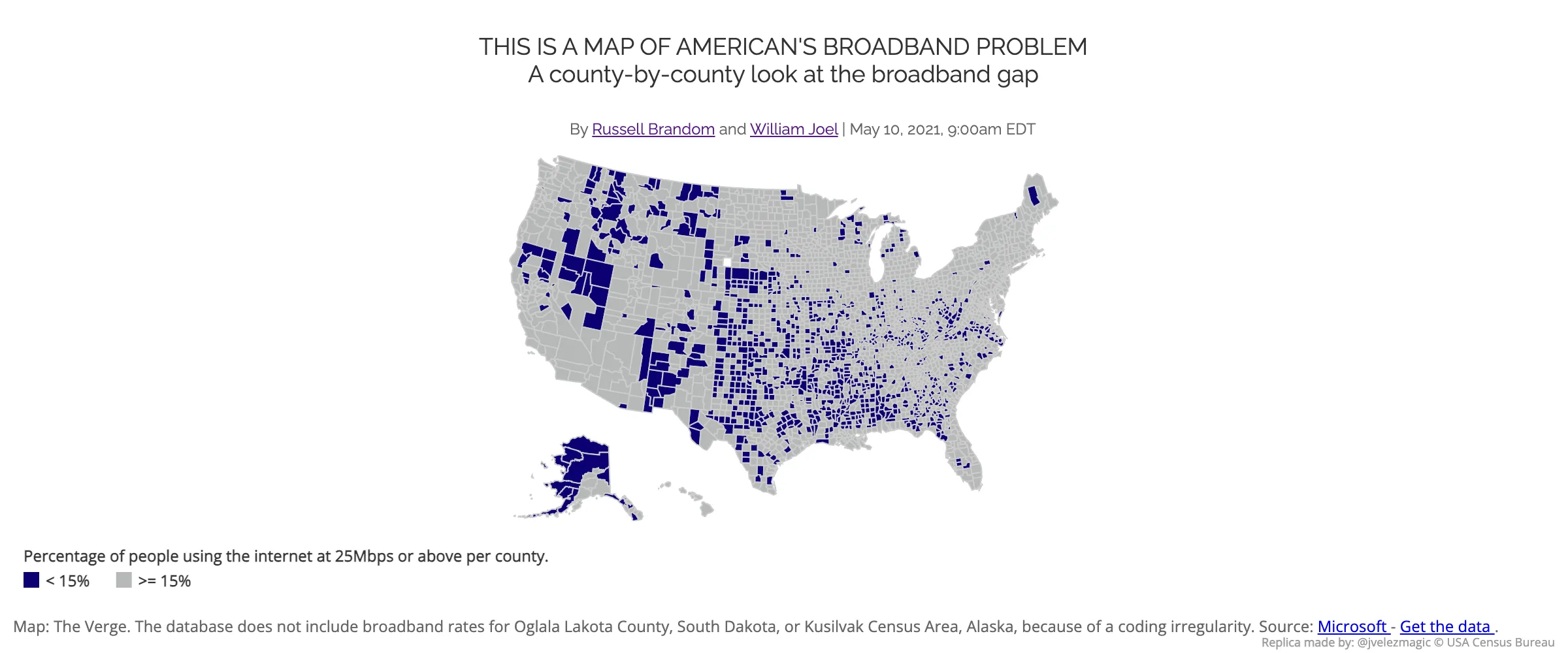
Congratulations, you have learned to create a handy map to share and show a problem of interest. I hope to see you soon with another blog. 😋✨✨✨
Session info
## ─ Session info ───────────────────────────────────────────────────────────────
##  setting  value
##  version  R version 4.0.5 Patched (2021-05-28 r80452)
##  os       macOS Big Sur 10.16
##  system   x86_64, darwin17.0
##  ui       X11
##  language (EN)
##  collate  en_US.UTF-8
##  ctype    en_US.UTF-8
##  tz       America/Mexico_City
##  date     2021-08-15
##
## ─ Packages ───────────────────────────────────────────────────────────────────
##  ! package      * version date       lib source
##  P assertthat     0.2.1   2019-03-21 [?] CRAN (R 4.0.2)
##  P backports      1.2.1   2020-12-09 [?] CRAN (R 4.0.2)
##  P bit            4.0.4   2020-08-04 [?] CRAN (R 4.0.2)
##  P bit64          4.0.5   2020-08-30 [?] CRAN (R 4.0.2)
##  P blogdown       1.4     2021-07-23 [?] CRAN (R 4.0.2)
##  P bookdown       0.23    2021-08-13 [?] CRAN (R 4.0.5)
##  P broom          0.7.9   2021-07-27 [?] CRAN (R 4.0.5)
##  P bslib          0.2.5.1 2021-05-18 [?] CRAN (R 4.0.5)
##  P cellranger     1.1.0   2016-07-27 [?] CRAN (R 4.0.2)
##    cli            3.0.1   2021-07-17 [1] CRAN (R 4.0.2)
##  P colorspace     2.0-2   2021-06-24 [?] CRAN (R 4.0.2)
##  P crayon         1.4.1   2021-02-08 [?] CRAN (R 4.0.2)
##    curl           4.3.2   2021-06-23 [1] CRAN (R 4.0.2)
##  P data.table     1.14.0  2021-02-21 [?] CRAN (R 4.0.2)
##  P DBI            1.1.1   2021-01-15 [?] CRAN (R 4.0.2)
##  P dbplyr         2.1.1   2021-04-06 [?] CRAN (R 4.0.2)
##  P digest         0.6.27  2020-10-24 [?] CRAN (R 4.0.2)
##  P dplyr        * 1.0.7   2021-06-18 [?] CRAN (R 4.0.2)
##  P ellipsis       0.3.2   2021-04-29 [?] CRAN (R 4.0.5)
##  P evaluate       0.14    2019-05-28 [?] CRAN (R 4.0.1)
##    fansi          0.5.0   2021-05-25 [1] CRAN (R 4.0.2)
##  P forcats      * 0.5.1   2021-01-27 [?] CRAN (R 4.0.2)
##  P fs             1.5.0   2020-07-31 [?] CRAN (R 4.0.2)
##  P generics       0.1.0   2020-10-31 [?] CRAN (R 4.0.2)
##  P ggplot2      * 3.3.5   2021-06-25 [?] CRAN (R 4.0.2)
##  P glue           1.4.2   2020-08-27 [?] CRAN (R 4.0.2)
##  P gtable         0.3.0   2019-03-25 [?] CRAN (R 4.0.2)
##  P haven          2.4.3   2021-08-04 [?] CRAN (R 4.0.2)
##  P highcharter  * 0.8.2   2020-07-26 [?] CRAN (R 4.0.2)
##  P hms            1.1.0   2021-05-17 [?] CRAN (R 4.0.2)
##  P htmltools      0.5.1.1 2021-01-22 [?] CRAN (R 4.0.2)
##  P htmlwidgets  * 1.5.3   2020-12-10 [?] CRAN (R 4.0.2)
##  P httr           1.4.2   2020-07-20 [?] CRAN (R 4.0.2)
##  P igraph         1.2.6   2020-10-06 [?] CRAN (R 4.0.2)
##  P janitor      * 2.1.0   2021-01-05 [?] CRAN (R 4.0.2)
##  P jquerylib      0.1.4   2021-04-26 [?] CRAN (R 4.0.2)
##  P jsonlite       1.7.2   2020-12-09 [?] CRAN (R 4.0.2)
##  P knitr          1.33    2021-04-24 [?] CRAN (R 4.0.2)
##  P lattice        0.20-44 2021-05-02 [?] CRAN (R 4.0.2)
##  P lifecycle      1.0.0   2021-02-15 [?] CRAN (R 4.0.2)
##  P lubridate      1.7.10  2021-02-26 [?] CRAN (R 4.0.2)
##  P magrittr       2.0.1   2020-11-17 [?] CRAN (R 4.0.2)
##  P modelr         0.1.8   2020-05-19 [?] CRAN (R 4.0.2)
##  P munsell        0.5.0   2018-06-12 [?] CRAN (R 4.0.2)
##  P pillar         1.6.2   2021-07-29 [?] CRAN (R 4.0.2)
##  P pkgconfig      2.0.3   2019-09-22 [?] CRAN (R 4.0.2)
##  P purrr        * 0.3.4   2020-04-17 [?] CRAN (R 4.0.2)
##  P quantmod       0.4.18  2020-12-09 [?] CRAN (R 4.0.2)
##  P R6             2.5.0   2020-10-28 [?] CRAN (R 4.0.2)
##    Rcpp           1.0.7   2021-07-07 [1] CRAN (R 4.0.2)
##  P readr        * 2.0.1   2021-08-10 [?] CRAN (R 4.0.2)
##  P readxl         1.3.1   2019-03-13 [?] CRAN (R 4.0.2)
##  P renv           0.14.0  2021-07-21 [?] CRAN (R 4.0.2)
##  P reprex         2.0.1   2021-08-05 [?] CRAN (R 4.0.5)
##  P rlang          0.4.11  2021-04-30 [?] CRAN (R 4.0.5)
##  P rlist          0.4.6.1 2016-04-04 [?] CRAN (R 4.0.2)
##  P rmarkdown      2.10    2021-08-06 [?] CRAN (R 4.0.2)
##  P rstudioapi     0.13    2020-11-12 [?] CRAN (R 4.0.2)
##  P rvest          1.0.1   2021-07-26 [?] CRAN (R 4.0.5)
##  P sass           0.4.0   2021-05-12 [?] CRAN (R 4.0.2)
##  P scales         1.1.1   2020-05-11 [?] CRAN (R 4.0.2)
##  P selectr        0.4-2   2019-11-20 [?] CRAN (R 4.0.2)
##  P sessioninfo    1.1.1   2018-11-05 [?] CRAN (R 4.0.2)
##  P snakecase      0.11.0  2019-05-25 [?] CRAN (R 4.0.2)
##    stringi        1.7.3   2021-07-16 [1] CRAN (R 4.0.2)
##  P stringr      * 1.4.0   2019-02-10 [?] CRAN (R 4.0.2)
##    tibble       * 3.1.3   2021-07-23 [1] CRAN (R 4.0.2)
##  P tidyr        * 1.1.3   2021-03-03 [?] CRAN (R 4.0.2)
##  P tidyselect     1.1.1   2021-04-30 [?] CRAN (R 4.0.5)
##  P tidytuesdayR * 1.0.1   2020-07-10 [?] CRAN (R 4.0.2)
##  P tidyverse    * 1.3.1   2021-04-15 [?] CRAN (R 4.0.2)
##  P TTR            0.24.2  2020-09-01 [?] CRAN (R 4.0.2)
##  P tzdb           0.1.2   2021-07-20 [?] CRAN (R 4.0.2)
##  P usethis        2.0.1   2021-02-10 [?] CRAN (R 4.0.2)
##    utf8           1.2.2   2021-07-24 [1] CRAN (R 4.0.2)
##  P vctrs          0.3.8   2021-04-29 [?] CRAN (R 4.0.5)
##  P vroom          1.5.4   2021-08-05 [?] CRAN (R 4.0.5)
##  P widgetframe  * 0.3.1   2017-12-20 [?] CRAN (R 4.0.2)
##  P withr          2.4.2   2021-04-18 [?] CRAN (R 4.0.2)
##  P xfun           0.25    2021-08-06 [?] CRAN (R 4.0.2)
##  P xml2           1.3.2   2020-04-23 [?] CRAN (R 4.0.2)
##  P xts            0.12.1  2020-09-09 [?] CRAN (R 4.0.2)
##  P yaml           2.2.1   2020-02-01 [?] CRAN (R 4.0.2)
##  P zoo            1.8-9   2021-03-09 [?] CRAN (R 4.0.2)
##
## [1] /Users/jvelezmagic/Documents/Github/personal_projects/jvelezmagic/renv/library/R-4.0/x86_64-apple-darwin17.0
## [2] /private/var/folders/bt/17212s6j0xxfjty0f77xmfq00000gn/T/Rtmp0EWnq6/renv-system-library
##
##  P ── Loaded and on-disk path mismatch.